

Viewmodel
This datapack makes animating viewmodels with OBJMC easier!
 9
9
Quick challenge
How far can you run before the mobs catch you?
Minecraft check
Confirm your run
Complete the quick check to get your code.
Viewmodel
``` ```
About Me
Vanilla Viewmodels is a Datapack Library which adds an "animation controller" for your OBJMC rendered viewmodels ingame. To work with the datapack, you must have: - An Animated (Generic in Blockbench) Model. - objmc installed locally. - A Basic Understanding of How Resourcepacks and Datapacks work. ``` ```
Utility:
- ## How it works. Since objmc only exports model+texture, it should be noted that the datapack adopts certain conventions to make sure that it works as intended. OBJMC, by default, will not "prepare you a datapack/resourcepack" like how plugins like AnimatedJava does. Hence, creating a resourcepack that correctly follows this datapack's convention is CRUCIAL.
Model in Resourcepack
The optional 'id' parameter accepted in the "play-animation" utils command requires a valid item_model component value. Since every objmc animation exports into its own model+texture, you must: - Create an Item Model JSON that resembles the model. `e.g. 'first_person:weapons/glock' at assets/first_person/items/weapons/glock.json` - Animations for the Model MUST be included in this item_model folder, where the "model with animation" is a model toggled when STRING CUSTOM-MODEL-DATA value === ANIMATION-NAME.
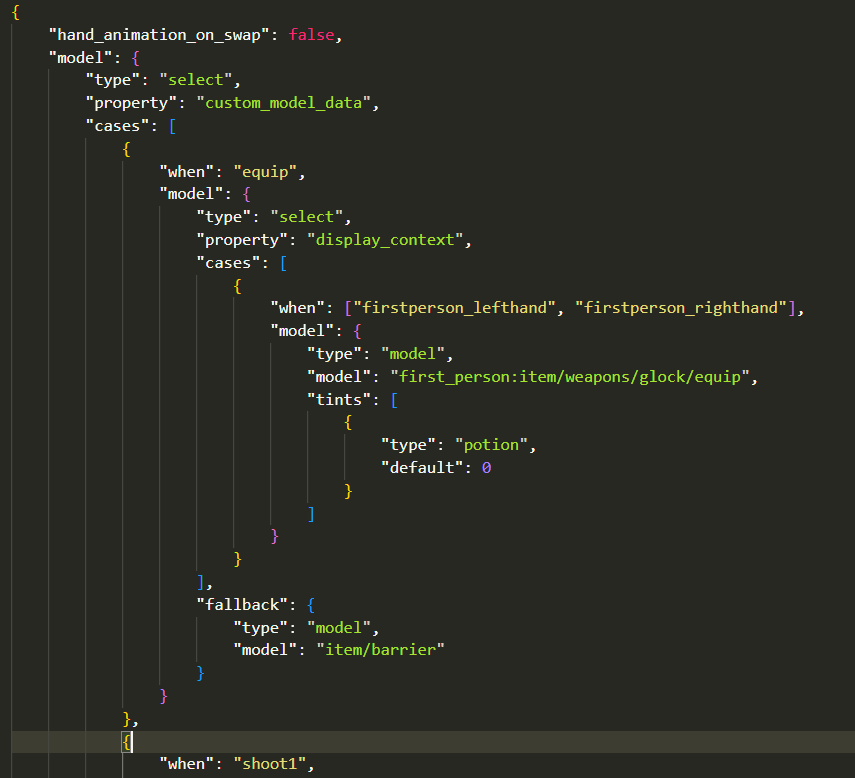
Hence, every animation is a CustomModelData string in the item_model JSON file. Obviously, this implies that adding multiple animations would mean that you'll have to export every animation into its OBJ sequences => put them through OBJMC.py => take the condensed model and mention it in the item_model component.
Registering Models in Datapack.
To Register an OBJMC Animated Model in the datapack, open the function file `vm:global/load` and add a registry in the data modify line!

Here's how a registry entry's structure looks like: ``` { id: "first_person:weapons/glock", // item_model component animations: [ { "name":"equip", "start": 0, "end": 30, keyframe_functions: [ { at: 0, function_file: 'test:equip' }, // Run a function file @ 0th keyframe. { at: 30, function_file: 'test:end_animation' }, { at: 25, function_file: 'test:gun_sfx' } ] }, { "name": "shoot1", "start": 0, "end": 8, "keyframe_functions": [ { at: 0, function_file: 'gun:shoot' } ] } ] } ```
- ## Playing an Animation to play an Animation, run the command: ``` function vm:animations/play {args:{}} ``` the `args:{}` field is used to tweak parameters, namely: ``` id: it stores/applies the *item_model* component value animation: it stores the name of the animation. frame: the frame at which the animation should start. ``` an example command: ``` function vm:animations/play {args:{id:"first_person:weapons/glock", animation: "equip", frame: 10}} ``` This command will, - change the item model of the potion item to first_person_weapons/glock - set the animation-to-be-played to "equip" (this is handled by setting animation name equal to custom_model_data string that changes the model into one with different animation texture data) - set the starting frame to 0 (potion color is set to 8388608+10) ``` ``` - ## Stopping an Animation to stop an animation, simply run the command: ``` function vm:animations/stop ``` ``` ```
Credits
- Godlander [& the contributors on objmc github repository.] —— For Making OBJMC (and thus, viewmodels) in Minecraft possible! - GhostScoutW (@ghostscout on discord) —— For making a Guide on how to setup a working viewmodel project with OBJMC! - pinkiuses (creator of ATMOS: Minecraft Edition) —— For coming up with the idea of using OBJMC as viewmodels! - And you!
