

CLab
Bringing Hardware Occlusion Culling (HOC) to Minecraft entity rendering optimization.
 83
83
Quick challenge
How far can you run before the mobs catch you?
Minecraft check
Confirm your run
Complete the quick check to get your code.
CLab
> Bringing Hardware Occlusion Culling (HOC) to Minecraft entity rendering optimization.
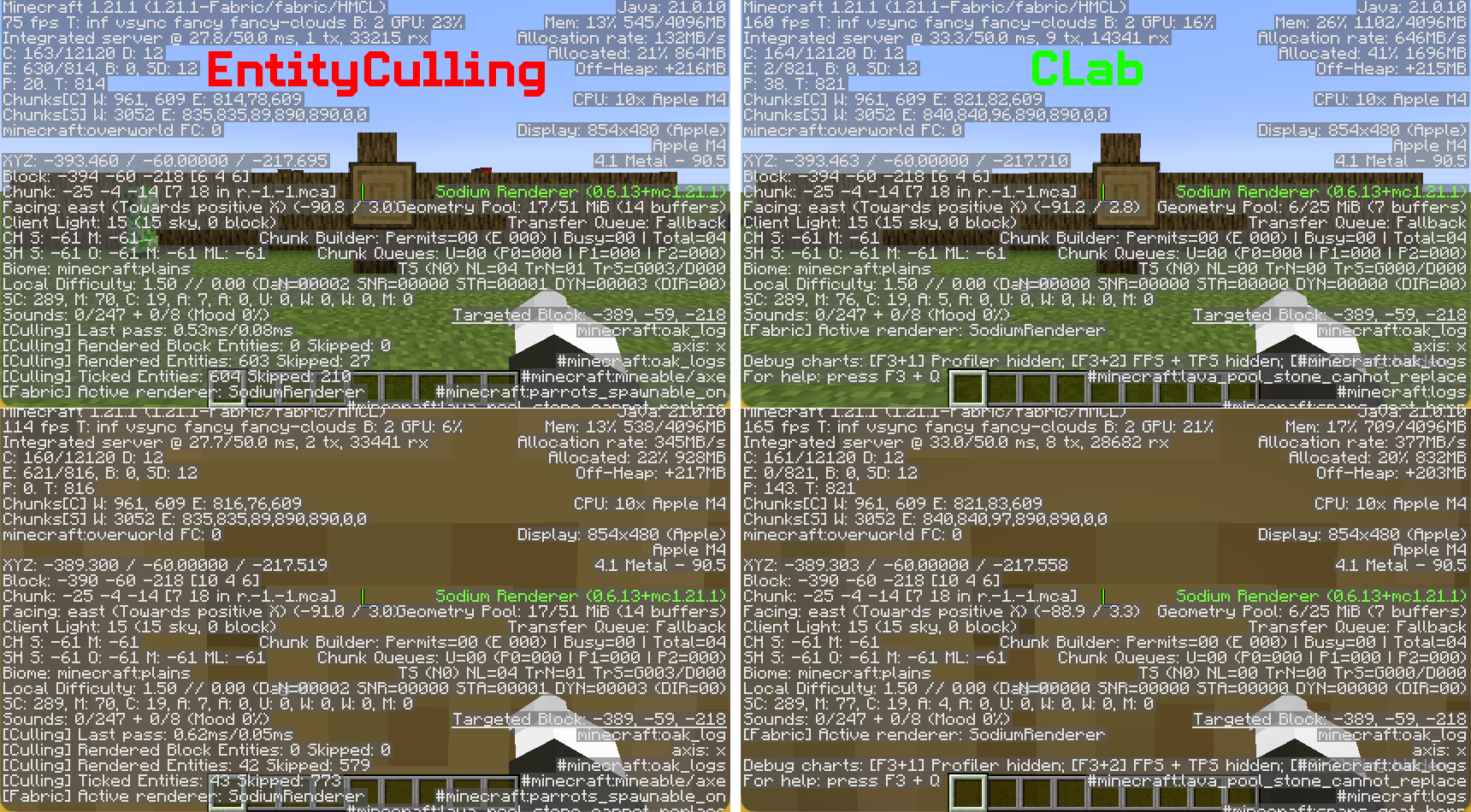
CLab is a client-side rendering optimization mod. It leverages GPU OpenGL occlusion queries to determine entity visibility directly, eliminating the approximation errors and side effects inherent to traditional CPU-side pathtracing.
Core Features
- Hardware Occlusion Culling (HOC) Uses GPU queries to test entity bounding boxes against the depth buffer, measuring real occlusion against actually rendered terrain rather than CPU-side approximations of the world model.
- Zero False-Positive Culling Based on ground-truth depth buffer testing. An entity is never hidden if even a single pixel is visible. No whitelist needed, no per-mod patches required.
- Render-Layer Only, Zero Intrusion Only decides whether to invoke the entity render method. Does not interfere with client-side ticks, animation states, position interpolation, or any logic. Trains, vehicles, and contraptions behave normally.
- Built-in Leaf Face Culling Automatically culls leaf faces occluded by adjacent leaves, reducing terrain rendering overhead.
- Zero-Config, Works Out of the Box No entity whitelist, no distance threshold, no tick-culling toggle. Install and play.
Technical Overview
CLab uses Hardware Occlusion Culling:
1. During entity rendering, submit the entity bounding box to the GPU as an occlusion query (OpenGL Query). 2. The GPU compares the bounding box against the already-rendered terrain depth buffer at the hardware level. 3. Read the previous frame's query result: if no pixels passed the depth test, skip rendering this entity.
This creates a fundamental difference:
| Aspect | CPU Pathtracing | CLab HOC | |--------|---------------|----------| | Occlusion basis | Simplified assumptions about world model | Actual GPU-rendered depth buffer | | False positives (hiding visible entities) | Common (near non-solid blocks) | Extremely unlikely | | Entity tick/animation | Often frozen or skipped | Completely unaffected | | CPU overhead | Continuous background traversal | Render thread submits AABB only; GPU handles the rest asynchronously | | Configuration required | Whitelists, distance limits, thresholds as compensatory mechanisms | None required |
⚠️ Important Compatibility Notes
* EntityCulling CLab requires a dedicated graphics card with EntityCulling. Most modern GPUs meet this requirement, but certain older integrated graphics or outdated drivers may not. * EntityCulling CLab should EntityCulling be installed alongside EntityCulling or any other mod that modifies entity/block entity visibility. While these mods use different techniques, they all ultimately override the same visibility decisions. Running more than one will not improve performance — instead, they may conflict and cancel out each other's optimizations, resulting in wasted resources and potential visual inconsistencies. For the best results, keep only CLab active.
Compatibility & Future Optimizations
The current approach was chosen to maintain compatibility with older devices and macOS. A more advanced technique is available, but it would introduce compatibility problems on those systems. Development and testing are currently done on a Mac, which limits how far I can improve things today. I plan to transition to a machine with OpenGL 4.6 support soon, after which I’ll introduce a system that automatically selects the optimal method during loading.
